
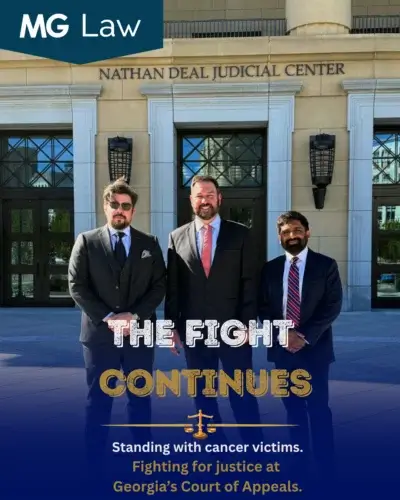
How the Georgia Court of Appeals rules in this ethylene oxide (EtO) case could reshape personal injury and product liability trials across the state.
A few weeks ago, I sat in the gallery as the Georgia Court of Appeals heard arguments in Walker v. Becton Dickinson and Company, involving MG Law client, Gary Walker. This suit is Georgia’s first ethylene oxide trial to reach a verdict and has become a landmark in the fight to hold sterilization plant operators accountable for toxic emissions. Our firm is proud to continue representing our local community and the families affected.
Last year, a Gwinnett County jury returned a $20 million compensatory verdict for Mr. Walker, finding that decades of negligent ethylene oxide emissions from Becton Dickinson’s Covington sterilization facility caused his non-Hodgkin lymphoma. The jury awarded an additional $50 million in punitive damages against the defendant but a mistrial of the punitive damages phase was declared after jury polling revealed the jurors were not unanimous in finding that the defendant acted with the specific intent the statute requires.
Of the many procedural and evidentiary issues raised on appeal, two should matter to every Georgia trial lawyer practicing in the post tort- “reform” landscape.
Issue One: Can a Hung Jury on Punitive Damages Undo a Valid Compensatory Verdict?
The first issue concerns bifurcation, or, here, trifurcation: what happens when a jury returns a complete verdict in one phase of trial but a mistrial is declared in the next? Does a hung jury on punitive damages wipe out a fully and properly decided compensatory verdict? The defense, predictably, wants exactly that result. If a deadlock on punitives could erase an otherwise sound compensatory finding, defendants would have every incentive to manufacture division in the final phase and force plaintiffs to re-litigate everything from the beginning.
Issue Two: Anchoring and the Reach of Georgia’s Tort “Reform” Law
The second issue is anchoring. Under O.C.G.A. § 9-10-184(c), a plaintiff’s arguments for monetary damages must be rationally related to the evidence admitted at trial:
In the trial of any action to recover damages for bodily injury or wrongful death, counsel for any party shall be allowed to argue the worth or monetary value of non-economic damages only after the close of evidence and at the time of such party's first opportunity to argue the issue of damages, provided that such argument shall be rationally related to the evidence of non-economic damages and shall not make reference to objects or values having no rational connection to the facts proved by the evidence.
But when the defendant’s revenues for one year come into evidence, through the defendant’s own documents, can the plaintiff reference that figure in arguing what the jury should award in compensatory damages for one year of the plaintiff’s suffering? The defense bar wants those numbers walled off from closing argument. The text and history of the statute say otherwise.
The legislature was trying to fix a specific problem, and that problem tells us how narrow this rule is. When the bill’s sponsors and the Governor described the new law, they pointed to lawyers using random, made up benchmarks, things like the price of fighter jets, truck mileage, or professional athletes’ salaries. That is exactly what the statute bans: “objects or values having no rational connection to the facts proved by the evidence.” O.C.G.A. § 9-10-184(c)(1). The feature all of those bad examples share is that the number comes from outside the case and has nothing to do with what the defendant did or what the plaintiff went through.
The closing argument in Walker was the opposite. The revenue figure was BD’s own number, drawn from BD’s own document, admitted at trial, shown to the jury repeatedly, and tied directly to the Covington plant whose emissions caused Walker’s cancer. A figure that is rooted in the defendant’s own evidence about the very facility at issue certainly seems like the opposite of an arbitrary, outside-the-case benchmark. It’s precisely the kind of value that is rationally connected to the facts proved at trial.
How the Court of Appeals resolves this question could shape closing arguments in every serious personal injury and product liability case tried in Georgia going forward.
More Than a Legal Question: A Family, and a Community
As consequential as these issues are, this case is ultimately about a family that has lived through diagnosis, treatment, and years of uncertainty while a multibillion dollar company litigates. Our firm represents hundreds of additional Covington area claimants diagnosed with lymphomas, leukemia, and other blood cancers tied to the same facility. We will keep doing the work.
Frequently Asked Questions
It is the first Georgia ethylene oxide case to reach a verdict. A Gwinnett County jury found that EtO emissions from Becton Dickinson’s (formerly C.R. Bard) Covington sterilization plant caused Gary Walker’s non-Hodgkin lymphoma and awarded $20 million in compensatory damages.
The jury initially awarded $50 million in punitive damages, but when the court polled the jury, the jurors were not unanimous on whether the defendant acted with the specific intent the law requires. That lack of unanimity led to a mistrial of the punitive damages phase, one of the central issues now on appeal.
People who lived or worked within 5 miles of the Covington sterilization facility and were later diagnosed with glioblastoma, lymphoma, leukemia, or other blood cancers may have a claim. Every situation is different, and eligibility depends on exposure history, diagnosis, and timing.
We’ve been in the community advocating for Covington residents since day one. That’s because we live and work in Covington. If you or a loved one lived or worked near the Covington sterilization plant and were later diagnosed with a blood cancer, MG Law can help you understand your options. We represent EtO clients across Georgia and continue to fight for the Covington community. Contact us for a free, confidential case evaluation.

Amer Ahmad is a former insurance defense lawyer who puts his knowledge of the insurance companies’ playbook to work for his clients. His practice includes helping families in wrongful death cases and individuals seriously injured by motor vehicle accidents, negligently maintained premises, and defective products. Amer has litigated hundreds of serious injury claims and taken numerous cases to jury verdict in Georgia courts.